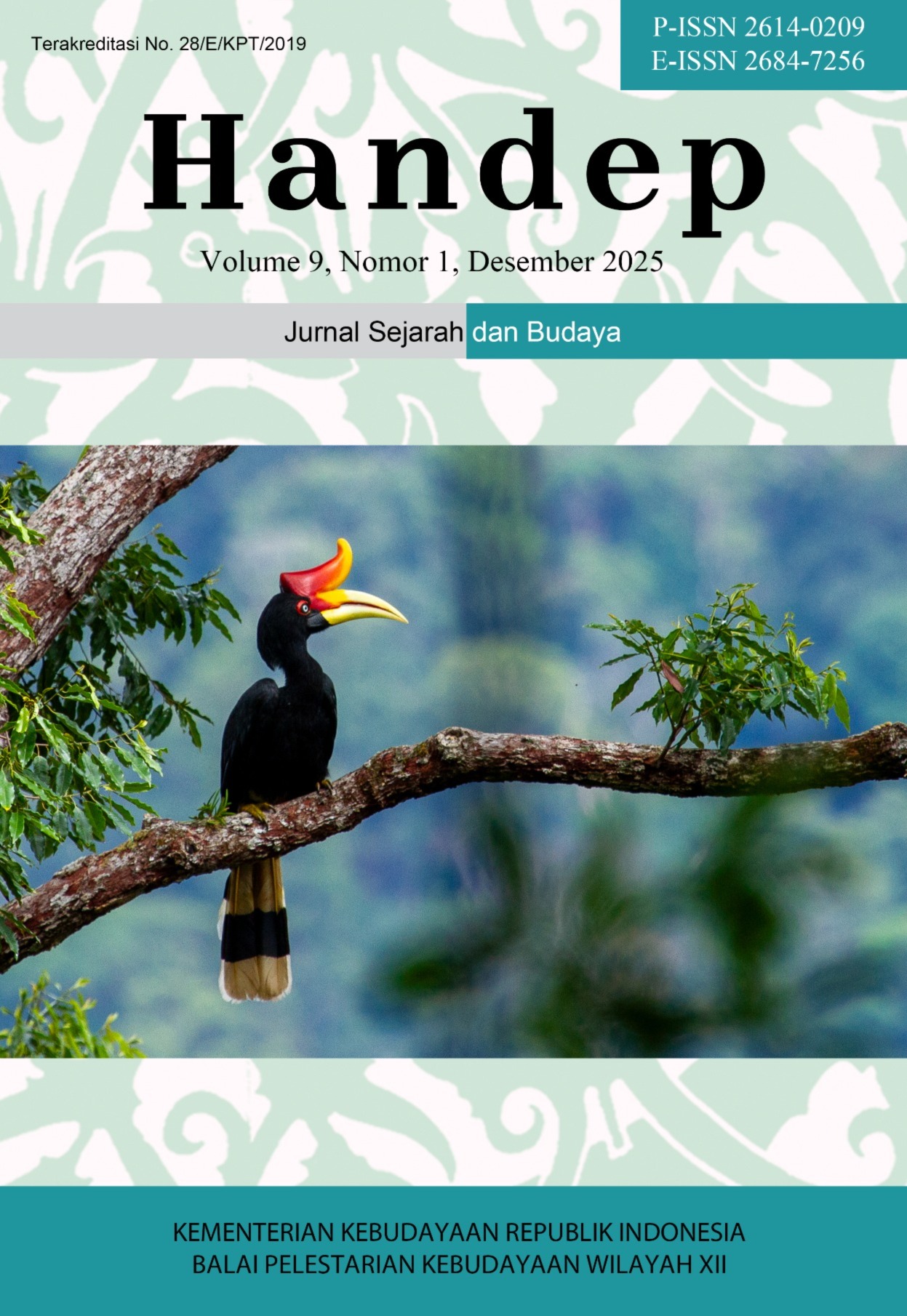
PERBURUAN ENGGANG DI KALIMANTAN AWAL ABAD KE-20: SUDUT PANDANG SISTEM DUNIA
DOI:
https://doi.org/10.33652/handep.v9i1.653Keywords:
hornbill, hunting, tree logging, and core-periphery.Abstract
The purpose of this article is to explain why hornbills in Kalimantan are endangered. The writing of this article applies historical methods starting from heuristics, criticism, interpretation to historiography by applying environmental history methodology, so this article also aims to explain the relationship between humans and the natural environment in the past that influenced each other. The theory applied in this article is the world system theory that integrates cultural and material aspects. In addition, this research uses the concept of insiders and outsiders to map the actors in the hunting and exploitation of North Kalimantan forests. Hunting and exploitation of timber in the forests of North Kalimantan in the 19th-20th centuries are the main factors why hornbills are endangered. Through this research, it was concluded that this long-standing system led to the introduction of materialism into the cultural aspects of the view of hornbills and Borneo forests. Until the early 20th century, hunting could be suppressed, but not completely stopped due to the established world market system. As an ecological consequence, the forests of North Kalimantan and Borneo as a whole can be referred to as peripheral areas that bear the ecological burden of hunting and trade sent to core areas such as China through international trade. Hornbill hunting in Kalimantan (Dutch Borneo) during the first three decades of the 20th century coincided with extensive exploitation of its Diptocarpaceae forest habitat. Using historical methods including heuristics, criticism, interpretation, and historiography within an environmental history framework this study traced how these activities led to habitat reduction and threatened hornbill populations. It explains the patterns of past interaction among humans, hornbills, and Kalimantan forests, along with their subsequent changes. This study argues that hornbill hunting and tree logging were not merely extractive activities but reflected the reinforcement of core-periphery relations under Dutch colonial influence. The global trade “world-system” yielded material benefits for core regions (several European and East Asian countries) and imposed ecological consequences on the periphery, including forest degradation and disruption of local subsistence. Therefore, the endangered status of the hornbill and the continued exploitation of Kalimantan’s timber into the 21st century represent a continuation of a long and complex historical process. An environmental history perspective is essential to illuminate these previously overlooked dimensions.
References
Anonim. 1884. “Borneo.” Algemeen Handelsblad. Juli, 13.
Anonim. 1886. “De Javaan en zijn vogels. Vervolg. De neushoorn-vogel (Buceros.)”. Soerabaijasch Handelsblad, November, 26.
Anonim. 1925. “Cultures en Handel. De Bosschen van de Z. en O afdeeling van Borneo.” De Locomotief. November, 9.
Anonim. 1934a. “Tengkawang. een Belangrijk Handelsartikel.” De Locomotief. Januari, 30.
Anonim. 1934b. “Wetenschappe-lijkheden Omtrent, Borneo Teak.” 1934. De Standaard, November, 16.
Balen, J. Hendrik van. 1914. De Dierenwereld van Insulinde in Woord En Beeld. Vol. 2. Deventer: Johs. J. C. Van der Burgh.
Beastall, Claire, Chris R. Shepherd, Yokyok Hadiprakarsa, dan Debbie Martyr. 2016. “Trade in the Helmeted Hornbill Rhinoplax Vigil: The ‘Ivory Hornbill.’” Bird Conservation International 26(2):137-46.
Berton, B. L. 1934. Statististisch Overzicht Betreffende Een Aantal Belangrijke Ned. Ind. Exportprodukten (in- En Uitvoeren, Prijzen, Etc.). Soerabaja: Makelaarskantoor J. Heiligers.
Braam, J. S. van. 1919. “Over Eenige van de Voornaamste Timmer-houtsoorten van Neder-landsch-Indië (Dipterocarpaceae).” De Indische Mercuur. Februari, 7.
Cleary, M. C. 1996. “Indigenous Trade and European Economic Intervention in North-West Borneo c.1860–1930.” Modern Asian Studies 30(2):301-24.
Cleary, Mark. 1997. “From Hornbills to Oil? Patterns of Indigenous and European Trade in Colonial Borneo.” Journal of Historical Geography 23(1):29-45.
Cribb, R. 1997, “Birds of Paradise, and Environmental Politics in Colonial Indonesia, 1890-1931”. Hlm. 379-407 dalam Paper Landscapes: Eexploration in the Environmental History of Indonesia, disunting oleh P. Boomgaard, D. E.F. Henley, dan F. Colombijn. Leiden: KITLV Press.
Davison, G. W. H. dan Chew Yen Fook. 2016. Birds of Borneo: Sabah, Sarawak, Brunei and Kalimantan. London: Bloomsbury Publishing Plc.
Departement van Landbouw, Nijverheid en Handel. 1932. Toelichting Op de Dierenbescher-mingsordonnantie En -Verordening 1931 En Jachtordonnantie En -Verordening 1931. Batavia: Landsdrukkerij.
Eghenter, Christina dan Bernard Sellato. 2003. “Introduction.” Hlm. 1-34 dalam Social Science Research and Conservation Management in The Interior Borneo: Unravelling Past and Present Interactions of People and Forests, disunting oleh B. Sellato, C. Eghenter, dan G. S. Devung. Jakarta: CIFOR.
Evans, Roz. 2016. “Asia Races to Save the Critically Endangered Helmeted Hornbill.” Diunduh 26 Desember, 2025 (https://news.mongabay. com/2016/11/asia-races-to-save-the-critically-endangered-helmeted-hornbill/).
Groeneveldt, W. 1939. Indische Vogels in Stad En Veld. Den Haag: H.P. Leopold Uitgeversmaatschappij N.V. ’s-Gravenhage.
Gustaman, Budi. 2022. Kolonialisasi Satwa: Eksploitasi, Kekerasan dan Wacana Kesejahteraan Satwa di Hindia Belanda. Depok: LP3ES.
Heyne, K. 1927. De Nuttige Planten van Nederlandsch Indië. Departement van Landbouw, Nijverheid & Handel.
Hornborg, Alf. 2007. “Introduction: Environmental History as Political Ecology.” Hlm. 1-24 dalam Rethinking Environmental History/ : World-System History and Global Environmental Change, disunting oleh A. Hornborg, J. R. McNeill, and J. Martinez-Alier. Lanham: AltaMira Press.
Irwin, Graham. 1955. “Nineteenth-Century Borneo: A Study in Diplomatic Rivalry.” Verhan-delingen van Het Koninklijk Instituut voor Taal-, Land- en Volkenkunde Vol. 15. Ser. Brill.
Kamerling, Z. 1929. “Neushoornvo-gels.” Tropisch Nederland.
King, Victor T. 1985. “Symbols of Social Differentiation: A Comparative Investigation of Signs, the Signified and Symbolic Meanings in Borneo.” Anthropos, 80 (1/3):125-52.
King, Victor T. 1987. “Reviewed Work(s): Punan Art and Artefacts by Neil J. Chadwick and P.P. Courtenay.” Museum Ethnographers Group 20.
Klinken, Gerry van. 2025. “Sistem Dunia dan Sejarah Lingkungan Hidup.”Diunduh 7 Oktober, 2025 (https://www.insideindonesia.org/topics/bacaan-bumi/9c-sistem-dunia-dan-sejarah-lingkungan-hidup).
Klokke, A. H. 1994. “Oorsprongsmy-then En Afbeeldingen van de Ngaju-Dayak Mihing; De Achtergrond van Een Bestaande Methode van Visvangst.” Bijdragen Tot de Taal-, Land- en Volkenkunde 150 (1).
Knapen, Han. 2001. Forests of Fortune? The Environmental History of Southeast Borneo, 1600-1880. Leiden: KITLV Press.
Krisdiana, Rita, Syafaruddin Usman, Uray Feri Andi, Allan Akbar, dan Mirza Ardi Wibawa. 2019. Menegakkan Kedaulatan dan Ketahanan Ekonomi: Bank Indonesia dalam Pusaran Sejarah Kalimantan Barat. Jakarta: Bank Indonesia Institute.
Lindblad, J. Thomas. 1988. Between Dayak and Dutch: The Economic History of Southeast Kalimantan, 1880-1942. Verhandelingen van Het Koninklijk Instituut Voor Taal- Land-en Volkenkunde. Dordrecht, Holland; Providence, [RI], U.S.A: Foris Publications.
MacKinnon, Kathy, G. Hatta, H. Halim, dan A. Mangalik. 1996. The Ecology of Kalimantan. Vol. 3. Singapore: Periplus Edition.
Mallinckrodt, J. 1924. Ethnographische Mededeelingen over de Dajaks in de Afdeeling Koealakapoeas (Res. Zuider- en Ooster Afd. van Borneo).
______. 2013. “Ethnografische Mede-deelingen Over De Dajaks In De Afdeeling Koealakapoeas.” Bijdragen Tot de Taal-, Land- en Volkenkunde 80.
Meurs, L. van, C. N. J. Delmaar, dan E. van der Laan. 1925. Lijst van de Tot Ultimo 1924 in de Dienstkring Zuider- En Oosterafdeeling van Borneo Aangetroffen Boomsoorten Met Opgave der Inlandsche Synoniemen en Latijnsche Benaming, Benevens Eene Klasse Indeeling der Houtsoorten en Een Overzicht der Voornaamste Handelshoutsoorten en Hun Gebruik.
Nijman, Vincent, dan Chris R. Shepherd. 2015. “Trade of ‘Captive-Bred’ Birds from the Solomon Islands: A Closer Look at the Global Trade in Hornbills.” Malayan Nature Journal 67(3):260-66.
Pflug, Kai. 2020. “Hornbills of Yunnan.” 10,000 Birds: Birds, Birding, and Blogging. 2020. Diunduh 7 Oktober, 2025 (https://www.10000birds. com/hornbills-of-yunnan.htm).
Potter, Lesley. 2005. “Commodity and Environment in Colonial Borneo. Economic Value, Forest Conversion and Concerns for Conservation, 1870-1940.” Hlm. 109-136 dalam Histories of the Borneo Environment, disunting oleh R. L. Wadley. Leiden: KITLV Press.
Rahmadi, R. 2015. “Enggang Gading yang Mendadak Kritis.” Diunduh 7 September, 2025 (https://mongabay.co.id/2015/12/16/enggang-gading-yang-mendadak-kritis/).
Rangkong Indonesia. n.d. “Ciri-Ciri Umum Enggang: Perkembang-biakan.” Diunduh 23 Agustus, 2025 (https://rangkong.org/ciri-ciri-umum/perkembangbiakan/ #content. Diakses 23 Agustus 2025).
Reyes, Raquel A. G. 2015. “Glimpsing Southeast Asian Naturalia in Global Trade, c. 300 Bce-1600 Ce.” Hlm. 96-119 dalam Environment, Trade and Society in Southeast Asia, A Longue Durée Perspective. Vol. 300, disunting oleh D. Henley dan H. S. Nordholt. Leiden: KITLV Press.
Saridan, Amiril, Andrian Fernandes, dan Massofian Noor. 2013. “Sebaran dan Potensi Pohon Tengkawang di Hutan Penelitian Labanan, Kalimantan Timur.” Jurnal Penelitian Penelitian Dipterokarpa 7 (2):101-8.
Scharer, Hans. 1963. Ngaju Religion: The Conception of God among a South Borneo People. Leiden: Springer-Science+Business Media, B.V.
Sellato, Bernard. 1993. “Myth, History and Modern Cultural Identity Among Hunter-Gatherers: A Borneo Case.” Journal of Southeast Asian Studies 24 (1):18-43.
________. 2001. Forest, Resources and People in Bulungan: Elements for a History of Settlement, Trade and Social Dynamics in Borneo, 1880-2000. Bogor: Center for International Forestry Research (CIFOR).
Sercombe, Peter G. dan Bernard Sellato. 2008. Beyond the Green Myth: Borneo’s Hunter-Gatherers in the 21st Century. NIAS Press.
Siccama, G. F. H. W. Rengers Hora. 1939. 3 Jaren Indisch Natuurleven. Batavia: Nederlandsch-Indische Vereeniging tot Natuurbescherming.
Snepvangers, F. W. 1930. “Het Boschwezen pp de Buitengewesten in Nederlandsch-Indië.” Nederland-sch Boschbouw-Tijdschrift, :351-60.
Sumihadi, Rafdinal, dan Riza Linda. 2019. “Kepadatan dan Pola Penyebaran Ficus Spp. di Stasiun Penelitian Cabang Panti Taman Nasional Gunung Palung Kalimantan Barat.” Jurnal Protobiont 8 (3):115-21.
Tagliacozzo, Eric. 2005. “Onto the Coasts and into the Forests, Ramifications of the China Trade on the Ecological History of Northwest Borneo, 900 - 1900 CE.” Hlm. 25-60 dalam Histories of the Borneo Environment, disunting R. L. Wadley. Leiden: KITLV Press.
Topografische Inrichting. 1914. Overzichtskaart van Het Eiland Borneo.
Viersen, T. 1910. De Indische Dierenwereld in Woord En Beeld: Voor Het Lager Onderwijs in Ned. Indië. Menado: Gebr. Que.
Vries, W. P. 1910. Hikajat Midan, Orang Dajak. (F.B. Sanders, Penerjemah). Amsterdam-Soerabaia: Gebroeders Graauw’s Uitgevers-maatschappij en Boekhandel N.V.
Wadley, Reed L. dan Carol J. Pierce Colfer. 2004. “Sacred Forest, Hunting, and Conservation in West Kalimantan, Indonesia.” Human Ecology 32 (3):313-38.
Wallerstein, Immanuel. 2004. World-Systems Analysis: An Introduction. Durham: Duke University Press.
Watts, Michael. 2000. “Political Ecology.” Hlm. 257-274 A Companion to Economic Geography, disunting oleh E. Sheppard dan T.J. Barners. Oxford: Blackwell Publishing Ltd.
Wihardandi, Aji. 2013. “Empat Warga Negara Cina Selundupkan Paruh Enggang dari Indonesia.” Diunduh 7 September, 2025 (https://mongabay.co.id/2013/01/08/empat-warga-negara-cina-coba-selundupkan-paruh-enggang-dari-indonesia/).
Downloads
Published
Issue
Section
License
Copyright (c) 2026 Handep: Jurnal Sejarah dan Budaya

This work is licensed under a Creative Commons Attribution-NonCommercial 4.0 International License.
By submitting the manuscript of papers/articles to Handep: Jurnal Sejarah dan Budaya, the authors are agreed to the following terms stated in copyright and license. Please also read our Publication Ethics dan Screening for Plagiarism.
Copyright
Authors who wish to publish and disseminate their papers with Handep: Jurnal Sejarah dan Budaya, shall agree to the publishing rights set by Handep: Jurnal Sejarah dan Budaya. Authors understand that they shall assign publication right to Handep: Jurnal Sejarah dan Budaya as part of the process upon acceptance for publication. The authors agreed that they will transfer certain copyrights to Handep: Jurnal Sejarah dan Budaya (authors must transfer the copyright by using the downloaded form HERE). Consecutively, authors still retain the right to use and share their own published articles without written permission from Handep: Jurnal Sejarah dan Budaya, as long as attributed properly, that the articles are initially published at Handep: Jurnal Sejarah dan Budaya.
Authors granted Handep: Jurnal Sejarah dan Budaya these following rights; (1) the right to publish and provide the manuscripts in all forms and media for publication and dissemination, (2) the authority to enforce the rights in the manuscript, for example in the case of plagiarism or copyright infringement.
License
Works in Handep: Jurnal Sejarah dan Budaya licensed under Creative Commons Attribution license. Users are free to copy and redistribute the material in any medium or format, remix, transform, and build upon the material under these terms; users must give appropriate credit, provide a link to the license, and indicate if changes were made. Users may do so in any reasonable manner, but not in any way that suggests the licensor endorses users or their usage.