THE STRUCTURE OF MUSIC PRESENTATION IN BALIATN RITUAL OF DAYAK KANAYATN
DOI:
https://doi.org/10.33652/handep.v3i2.93Keywords:
baliatn ritual, Dayak Kanayatn, and traditional musicAbstract
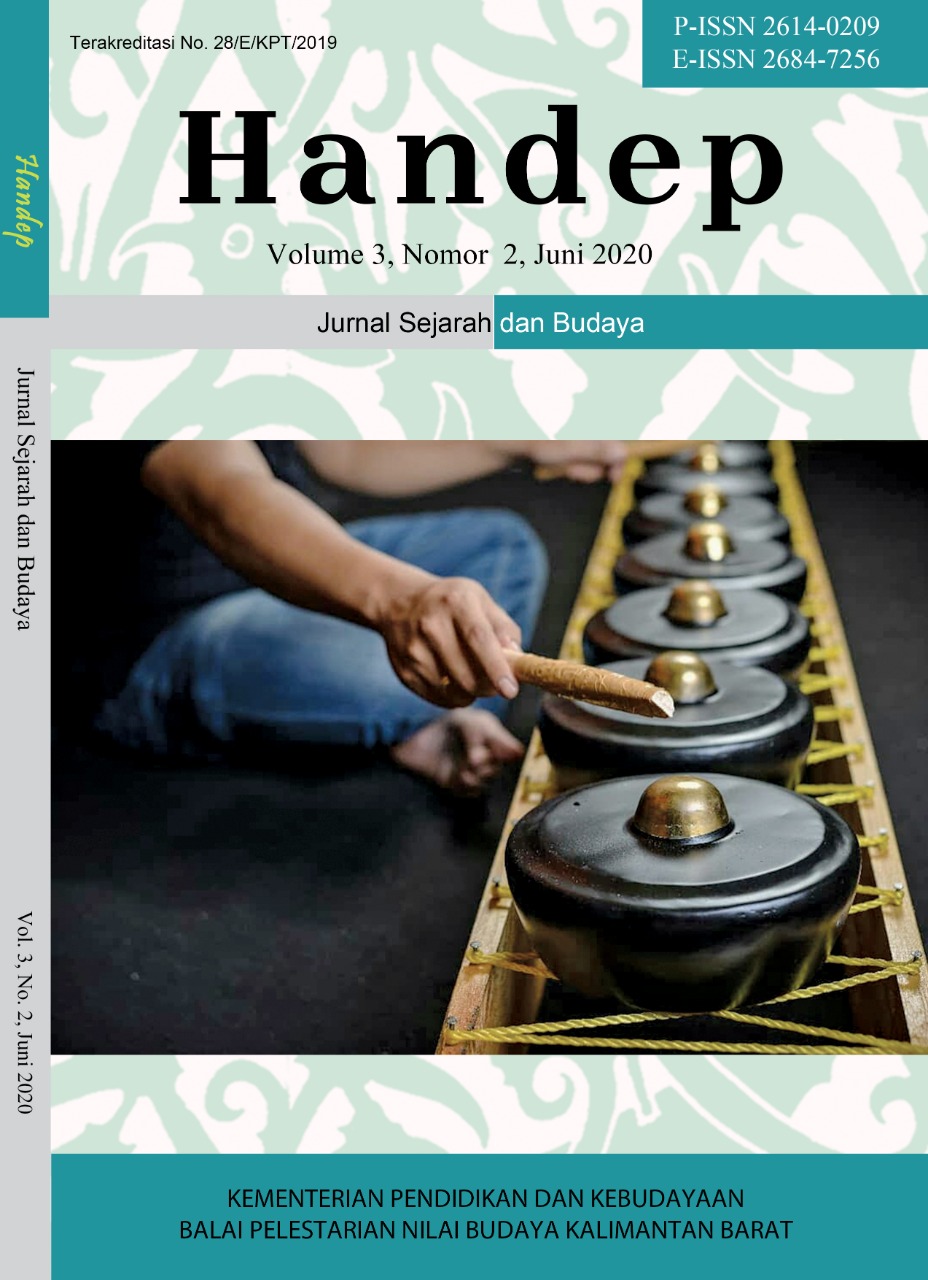
Traditional music in baliatn ritual has a composition or structure of special music presentation which can influence pamaliatn or tukang liatn (the ritual leader) to experience the transcendental period. Besides, the music played can incur the magical power, it indicates how strong the effect of the sound or voice of gongs, dau, and gadobokng that were played during baliatn ritual. The research problem was how does the structure of music presentation in baliatn ritual of Dayak Kanayatn? Thus, the purpose of this research was to describe and analyze the problem in the structure of music presentation of baliatn ritual. The research used descriptive method in qualitative research design. The study has found that the structure of music presentation in baliatn ritual held in three steps; the beginning part is guntur mandayu beating motif, the main part is ka ‘bawakng beating motif, and the final part is ne’ unte beating motif. In this research, the researcher also made the notation of Dayak Kanayatn music in special and simple way.
References
Agu, D.C.C. 2015. “The Application of Individual Knowledge System in Music Education and Practice in Nigeria.” Journal of Nigerian Music Education 7:1-8
Artistiana, Rilla.2010. Aneka Alat Musik Daerah. Jakarta: Horizon.
B a n d e m , I M a d e . 2 0 0 1 . “Etnomusikologi Penyelamat Musik Dunia.” Selonding: Jurnal Etnomusikologi Indonesia 1(1):1- 2
Haryanto. 2015. Musik Suku Dayak; Sebuah Catatan Perjalanan di Pedalaman Kalimantan. Yogyakarta: ISI Yogyakarta.
Hidayat, Atep Afia. 2015. Diunduh Mei, 2020 (http://info-kotakita.blogspot. com/2015/01/kota-mempawahhulu.html).
Hornbostel, E.M & Sachs, C. 1961. “Classification of Musical Instruments: Translated from the Original German by Anthony Baines and Klaus P. Wachsman.” The Galpin Society Journal, 14:3-29
Miden, Maniamas. 1997. Mencermati Dayak Kanayatn. Pontianak: Institute of Dayakology Research and Development.
Moleong, Lexy J. 1991. Metodologi Penelitian Kualitatif. Bandung: Remaja Rosdakarya.
Morgan, Stephanie dan Theresia Game. 1992. Manual untuk Peneliti Lapangan Proyek Tradisi Lisan (Sastra Lisan Pulau Kalimantan), Pontianak: Borneo Research Bull etin-Yayasan Lem baga Pelestarian Budaya Kanayaan.
Nnamani, N.S. 2014. “The Role of Folk Music in Traditional African Society: The Igbo Experience.” Journal of Modern Education Review 4(4): 304-310.
Olendo, Yudhistira Oscar. 2017. Musik Tradisional dalam Ritus Liatn pada Masyarakat Dayak Kanayatn. Tesis. Bandung: Program S t u d i P e n d i d i k a n Seni, Sekolah Pa sca sa rja na Un iver sita s Pendidikan Indonesia.
Sukanda, Alexander Yan. 2010. Tradisi Musikal dalam Kebudayaan Dayak Aktualisasi dan Transformasi. Pontianak: Institut Dayakologi.
Supanggah, Rahayu. 1995. Etnomusikologi. Yogyakarta: Yayasan Bentang Budaya.
Downloads
Published
Issue
Section
License
By submitting the manuscript of papers/articles to Handep: Jurnal Sejarah dan Budaya, the authors are agreed to the following terms stated in copyright and license. Please also read our Publication Ethics dan Screening for Plagiarism.
Copyright
Authors who wish to publish and disseminate their papers with Handep: Jurnal Sejarah dan Budaya, shall agree to the publishing rights set by Handep: Jurnal Sejarah dan Budaya. Authors understand that they shall assign publication right to Handep: Jurnal Sejarah dan Budaya as part of the process upon acceptance for publication. The authors agreed that they will transfer certain copyrights to Handep: Jurnal Sejarah dan Budaya (authors must transfer the copyright by using the downloaded form HERE). Consecutively, authors still retain the right to use and share their own published articles without written permission from Handep: Jurnal Sejarah dan Budaya, as long as attributed properly, that the articles are initially published at Handep: Jurnal Sejarah dan Budaya.
Authors granted Handep: Jurnal Sejarah dan Budaya these following rights; (1) the right to publish and provide the manuscripts in all forms and media for publication and dissemination, (2) the authority to enforce the rights in the manuscript, for example in the case of plagiarism or copyright infringement.
License
Works in Handep: Jurnal Sejarah dan Budaya licensed under Creative Commons Attribution license. Users are free to copy and redistribute the material in any medium or format, remix, transform, and build upon the material under these terms; users must give appropriate credit, provide a link to the license, and indicate if changes were made. Users may do so in any reasonable manner, but not in any way that suggests the licensor endorses users or their usage.